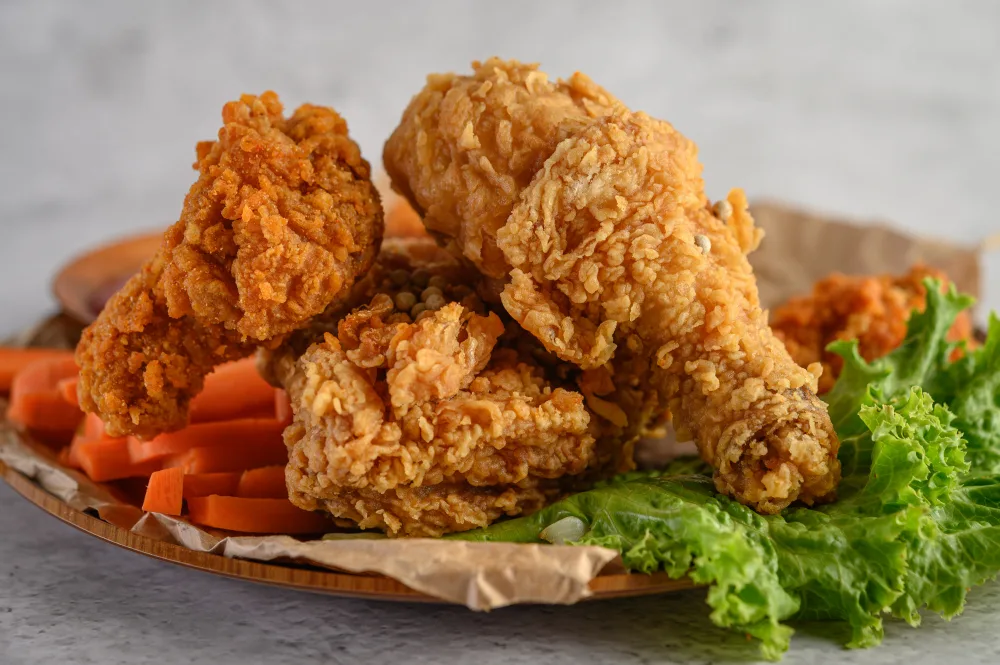
Breading stays attached when each layer has a job: the food surface is dry enough for flour to grip, the liquid bonds to that flour and the outer coating is given time to settle before frying.
When the crust separates, the failure often occurred before the food reached the oil. Wet surfaces create a slippery boundary; bare patches of flour leave nothing for the liquid to hold; rough handling tears the coating. Oil conditions then determine how quickly the exterior sets. Texture technique must remain separate from safe internal temperature, which depends on the food.
Prepare a dry, even surface
Pat the ingredient dry and remove loose frost or marinade. Season deliberately, but avoid leaving pools of liquid. A thin, complete flour layer absorbs remaining surface moisture and creates texture for the next layer. Shake off excess: thick dry pockets can hydrate unevenly and split away as steam forms.
Build continuous layers
Use one hand for dry ingredients and the other for wet to prevent clumps. Coat every edge with flour, then liquid, then crumbs or the chosen outer layer. Press gently instead of crushing. If the liquid runs straight off, the first layer is incomplete; if the crumbs form heavy islands, too much liquid remains.
Rest and handle with intention
A short rest on a rack lets the coating hydrate and adhere. Move pieces by uncoated edges where possible and lower them into oil away from the body. Turn only after the first side has formed a stable crust. Tongs that pinch through the surface or repeated flipping can detach a coating that otherwise bonded correctly.
Protect the frying environment
Adding too much cold food at once drops oil temperature and increases steam and oil absorption. Fry in workable batches and let the oil recover, using an appropriate thermometer and the recipe's tested range. USDA notes that appearance alone does not establish safe doneness for meat, poultry or seafood; verify the food-specific internal temperature after removal.
Failure-to-fix guide
| Failure | Likely stage | Change |
|---|---|---|
| Whole shell slides off | Food surface was wet or smooth | Dry thoroughly and apply an even flour layer |
| Bald patches | Incomplete flour or liquid coverage | Coat edges and shake off only loose excess |
| Crust tears while turning | Turned early or gripped too hard | Wait for setting and handle less |
| Soft, oily coating | Crowded batch or poor recovery | Use smaller batches and monitor oil |
A repeatable coating sequence
- Dry and portion food evenly.
- Apply a thin complete flour coat.
- Cover with liquid without puddles.
- Add the outer layer and rest on a rack.
- Fry in batches, turn sparingly and verify safe doneness.
A coating that holds is built before frying and protected during frying. Fix the failed layer instead of compensating with more crumbs, hotter oil or longer cooking.